Bringing History to Life: A Practical Guide to Presidents' Day Reading Comprehension
Finding the right educational material that balances historical facts with engaging storytelling can feel like searching for a needle in a haystack, especially when you are trying to connect young learners with the significance of national holidays. Presidents' Day Reading Comprehension resources offer a bridge between dry textbook dates and the living legacy of American leadership. For educators, homeschooling parents, and tutors working with grades 2 through 3, these tools are not just about filling out a worksheet; they are about sparking a conversation regarding civic values, leadership qualities, and the stories behind the symbols we see every day.
At its core, this type of learning material transforms the third Monday in February from a mere day off school into a meaningful exploration of history. When you utilize a well-crafted passage focused on figures like George Washington and Abraham Lincoln, you are providing students with more than just reading practice. You are offering them a lens through which to view responsibility, honesty, and perseverance. The magic happens when the text is accessible—written at a level where a second or third grader can decode the words independently but still encounter new vocabulary and complex ideas that stretch their thinking.
Real-World Applications Beyond the Classroom
While the most obvious setting for a Presidents' Day Reading Comprehension Worksheet is the traditional classroom during a social studies block, the utility of these resources extends far beyond those four walls. Consider the busy substitute teacher who walks into a room with no lesson plan left behind. Having a self-contained packet that includes a nonfiction passage, questions, and an answer key means the day runs smoothly without chaos. The students stay engaged with a thematic activity, and the sub has a clear guide to follow.
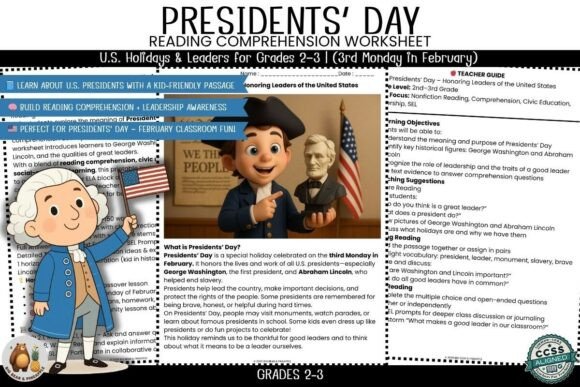
For homeschooling families, these materials often serve as the anchor for a week-long unit study. A parent might start with the reading passage on Monday, discussing the difference between Washington's military leadership and Lincoln's preservation of the union. By Wednesday, the family could visit a local history museum or look up U.S. symbols mentioned in the text, using the worksheet's illustration as a visual reference point. This approach turns a single sheet of paper into a multi-sensory experience.
Even in after-school programs or tutoring centers, these worksheets provide a structured way to address learning gaps. If a student struggles with finding text evidence, the specific questions included in high-quality packs force them to go back and underline exactly where the answer lives in the paragraph. It moves the skill from abstract theory to concrete practice. Furthermore, for early finishers in a mixed-ability classroom, these activities offer a meaningful extension that prevents boredom without requiring the teacher to invent a new task on the fly.
Tailoring the Experience for Different Learners
One of the strongest aspects of using targeted reading comprehension packs is the ability to differentiate instruction without creating entirely separate lessons. In a typical grade 2–3 classroom, reading levels can vary wildly. A resource designed with clear sentence stems for open-ended questions allows struggling writers to participate fully. Instead of staring at a blank line wondering how to start, a prompt like "George Washington showed leadership when..." gives them the scaffolding they need to express their understanding.
Conversely, advanced readers can be challenged to look deeper into the social-emotional learning (SEL) prompts often included in these modern worksheets. Rather than just recalling facts, they can debate what makes a "great leader" in today's world compared to the 1800s. This flexibility ensures that every child, regardless of their current academic standing, finds a point of entry into the subject matter. The inclusion of a teacher guide with lesson ideas further empowers educators to tweak the delivery based on whether their group responds better to discussion, drawing, or writing.
Key Considerations Before You Begin
Before downloading or printing any Presidents' Day Reading Comprehension material, it is wise to evaluate a few practical factors to ensure it meets your specific needs. First, check the word count and complexity. A passage that is too dense will frustrate emerging readers, while one that is too simple may not offer enough rigor for third graders. Ideally, you want a text around 150 words that introduces key terms like "inauguration," "legacy," or "symbol" within a context that makes their meaning clear.
Another critical consideration is the alignment with educational standards. Resources that explicitly mention CCSS (Common Core State Standards) codes like RI.2.1 or RI.3.2 save you time during lesson planning and administrative reporting. Knowing that the material asks students to "ask and answer questions" directly supports the literacy goals required for these grade levels. Additionally, look for materials that include an answer key with text evidence citations. This feature is invaluable for quick grading and for modeling how to justify answers, a skill that becomes increasingly important as students move into upper elementary grades.
Visual appeal also matters more than many realize. A high-quality 3D cartoon illustration does more than decorate the page; it provides a visual hook for visual learners and can be projected onto a smartboard for whole-group analysis. If the artwork is engaging, students are more likely to take pride in their completed work, perhaps even displaying it on a bulletin board to celebrate their learning.
Maximizing the Impact of Your Lesson
To get the most out of these resources, think of the worksheet as a launchpad rather than the final destination. Use the multiple-choice questions to gauge basic understanding quickly, but spend the majority of your energy on the open-ended sections. These are the moments where critical thinking flourishes. Encourage students to connect the historical figures to their own lives. How did Lincoln show respect? How can they show respect in the classroom today?
Integrating these readings into broader themes of citizenship helps solidify the concepts. When students understand that holidays like Presidents' Day are about honoring service and sacrifice, the reading comprehension becomes a civics lesson in disguise. Whether you are using this for a sub plan, a homework assignment, or a center rotation, the goal remains the same: to help young minds grasp the weight and wonder of history through the accessible medium of story.
Ultimately, the right reading pack simplifies your preparation while enriching the student experience. It takes the heavy lifting out of curriculum design, allowing you to focus on the interactions that matter most—the discussions, the "aha" moments, and the connections made between past leaders and future citizens. By choosing resources that blend rigorous questioning with engaging narratives, you ensure that the third Monday in February is remembered not just as a day without school, but as a day of meaningful discovery.