Mastering Realistic Faux Water Effects Using Hot Glue for Miniature Projects
Creating believable environments in miniature modeling, dioramas, and fairy gardens often hinges on one challenging element: water. Traditionally, achieving the look of flowing streams, cascading waterfalls, or still ponds required expensive resins, long curing times, and complex molding processes. However, make faux water effects using hot glue has emerged as a transformative technique for creators who need efficiency without sacrificing visual fidelity. This method, popularized by artists like Liyana, leverages the transparency and texture of standard hot melt adhesive to simulate liquid dynamics instantly.
For professionals and hobbyists alike, integrating this technique into your workflow solves several common bottlenecks. It eliminates the waiting period associated with epoxy, reduces material costs, and allows for iterative design changes that are impossible once resin hardens. Whether you are a set designer working under a tight deadline, an educator demonstrating landscape features, or a small business owner crafting unique decor, understanding how to manipulate hot glue into water features adds a versatile tool to your creative arsenal.
Strategic Integration into Your Creative Workflow
The decision to make faux water effects using hot glue should not be an afterthought; it is a strategic choice that impacts the planning, execution, and final quality of a project. In a professional context, this technique fits seamlessly into the mid-to-late stages of asset creation. Unlike resin, which requires a dedicated, ventilated space and precise mixing ratios, hot glue can be applied directly during the assembly phase.
Consider the workflow of a diorama builder. Typically, the base structure and terrain are built first, followed by vegetation and structural elements. Water features are often the final layer. By choosing hot glue, you maintain the flexibility to adjust the flow path or volume of the "water" right up until the moment of final sealing. If a riverbank looks uneven or a waterfall needs more volume, you can simply reheat the area and add more adhesive. This compatibility with rapid prototyping makes it ideal for entrepreneurs testing product designs or marketers creating visual content where speed to market is critical.
Furthermore, this method interacts efficiently with other materials. Hot glue adheres well to plastics, painted surfaces, and sealed woods, which are common substrates in miniature scenery. However, successful implementation requires understanding thermal compatibility. Applying boiling-hot glue to delicate foam or thin plastic sheets can cause warping. A prudent workflow involves testing adhesion on scrap pieces of your specific base material before committing to the main project. This simple quality control step prevents costly errors and ensures the longevity of your piece.
Essential Preparation and Material Selection
While the barrier to entry is low, the quality of your output depends heavily on preparation. To make faux water effects using hot glue effectively, you do not need a warehouse of supplies, but you do need the right grade of adhesive. Standard clear glue sticks are the foundation, but for larger bodies of water or deeper effects, high-temperature guns paired with thick, crystal-clear sticks yield better results. Low-temperature guns may struggle to create the smooth, glass-like finish required for realistic water, often leaving visible striations.
Organization is key before you begin. Have your heat gun or hair dryer ready for smoothing, along with tweezers for placing debris or miniature foliage into the wet glue. Some artists tint their glue slightly with translucent alcohol inks to mimic the greenish hue of deep water or the murky brown of a creek, though pure clear glue often works best for shallow, flowing water where light refraction is the primary visual cue.
Safety is also a component of professional preparation. Even though this is a craft technique, working with molten adhesive requires care. Ensure your workspace is clean and free of dust, as particles settling into the cooling glue can ruin the transparent effect. Having a dedicated mat or surface that can withstand high heat protects your work table and allows for easy cleanup of stray strands.
Execution Techniques for Diverse Water Features
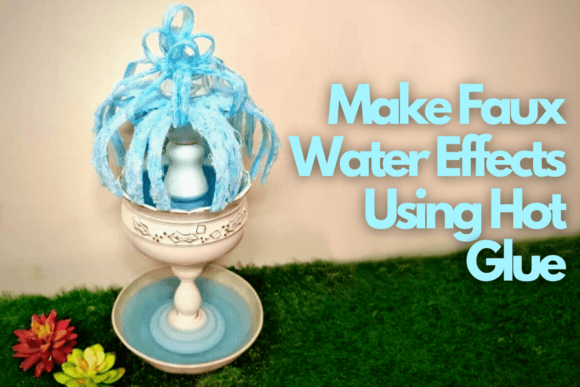
The core of this technique lies in how you apply the glue. Liyana's approach demonstrates that versatility comes from varying the application method. For a water fountain or a vertical waterfall, the goal is to create movement and turbulence. This is achieved by applying the glue in irregular, dripping motions rather than a smooth pour. As the glue cools, these ridges catch the light, mimicking the chaotic reflection of falling water. You can build this up in layers, allowing the bottom layer to set slightly before adding the next to create depth and opacity variations.
Conversely, creating a small river or creek requires a different touch. Here, the objective is smoothness with subtle undulations. Apply a generous amount of glue to fill the channel, then use a heat gun to gently melt the surface tension. This creates a self-leveling effect that resembles calm, flowing water. While the glue is still warm but no longer liquid, you can drag a toothpick or fine tool through it to create current lines or ripples around rocks and obstacles. This level of detail transforms a simple blob of plastic into a dynamic environmental feature.
One of the most powerful aspects of learning to make faux water effects using hot glue is the ability to embed elements within the water itself. Because the glue sets relatively quickly, you can place miniature fish, submerged stones, or aquatic plants into the adhesive and hold them in place for seconds until they bond. This creates a three-dimensional underwater scene that is difficult to achieve with flat painting techniques. For fairy gardens, this allows for the creation of magical, glowing pools where LED lights can be embedded beneath the glue layer, diffusing softly through the translucent medium.
Optimizing for Long-Term Durability and Aesthetics
While hot glue is excellent for visualization and display pieces, understanding its limitations is crucial for long-term usability. Hot melt adhesive can yellow over time if exposed to direct, intense UV light. For indoor dioramas, educational models, or retail displays kept away from windows, this is rarely an issue. However, for outdoor fairy gardens or installations in sunrooms, it is advisable to apply a UV-resistant clear coat over the finished water effect. This additional step seals the glue, protects it from degradation, and can even enhance the glossiness, making the water appear wetter.
Dust accumulation is another factor to consider in the maintenance of these projects. The textured surface of a faux waterfall can trap dust more easily than a smooth resin surface. Designing your project with accessibility in mind—perhaps ensuring the water feature is not recessed too deeply—allows for gentle cleaning with a soft brush or compressed air. This foresight ensures that your creation remains pristine for years, maintaining its value as a decorative asset or teaching aid.
Consistency in application is what separates amateur attempts from professional-grade scenery. Practice controlling the trigger of your glue gun to regulate flow rate. A steady hand produces uniform rivers, while a pulsing trigger creates natural-looking rapids. Keep a log of your settings: which gun temperature worked best for specific effects, how long you heated the surface for smoothing, and which brands of glue sticks offered the highest clarity. This documentation builds a personal knowledge base that streamlines future projects.
Expanding Applications Beyond Scenery
The skills gained when you make faux water effects using hot glue extend far beyond miniature landscapes. This technique is highly applicable in costume design for creating icy armor or crystalline accessories, in product photography for simulating condensation or spills without the mess of real liquid, and in therapeutic art activities where the tactile nature of the process is beneficial. Educators can use this method to teach principles of fluid dynamics and geography in a hands-on manner, allowing students to construct their own watershed models.
For freelancers and content creators, mastering this hack offers a unique selling point. Being able to deliver high-quality, custom miniature scenes quickly gives you a competitive edge in markets saturated with generic 3D renders or static images. The tangible, handcrafted quality of hot glue water effects resonates with audiences looking for authenticity and artisanal value.
Ultimately, the power of this technique lies in its simplicity and adaptability. It democratizes the creation of complex visual effects, putting them within reach of anyone with a basic toolkit. By focusing on preparation, understanding the material properties, and practicing varied application methods, you can integrate this skill smoothly into your existing workflows. Whether you are building a intricate model train layout, designing a whimsical garden display, or simply exploring a new creative outlet, the ability to conjure realistic water from a glue gun opens up a world of possibilities. Join the ranks of creators who have discovered that sometimes the most magical results come from the simplest tools, applied with precision and imagination.